Tag Archives: marine science

Harbor SEALs & MBRP Winter 2025-2026 Update

SEALs volunteers sample marine debris within a quadrat to compare debris accumulation year-on-year. (Photo credit: Mauricio Gonzalez)

The New York Harbor SEALs Civic Science Program is a NYC public school initiative that puts students to work on one problem that is already here and accelerating: extreme weather is reshaping shoreline conditions, water quality, and habitat stability in New York Harbor. Harbor SEALs students play a distinctive role in restoration by doing authentic scientific research and service learning, not one-off “exposure” activities. With 40+ high school volunteers and interns, students run student-managed fieldwork and lab work, teamwork, public outreach, marine resource management, and disciplined data management—the operational skills that make climate adaptation work succeed in the real world.

MBRP11 scholars on a virtual call with Nature Metrix and Deutsche Bank to discuss the eDNA marine biodiversity monitoring project set to begin this Fall in the NY Harbor.

Our work is built for climate resilience and adaptation because restoration decisions are only as good as the data underneath them. Students measure core physical and chemical parameters—temperature, salinity, dissolved oxygen, pH, turbidity (and related indicators)—to assess whether conditions are suitable for oyster and harbor seal survival, growth, and broader habitat function. Those measurements become decision-useful evidence that supports climate resilience planning, adaptive management, and habitat restoration.

SEALs intern, Sara Soto, surveys seawall panels installed to attract marine biodiversity (Photo Credit: Mauricio Gonzalez).

We focus on Governors Island and Lower Manhattan because this corridor is an ecological chokepoint: over four miles of shoreline exposed to intense tidal exchange and some of the densest urban pressures in the city. In wet weather, combined sewer overflows discharge stormwater mixed with untreated sewage into surrounding waters—exactly the kind of stressor that spikes during heavy rainfall and undermines long-term restoration gains. New York City’s combined sewer system includes hundreds of CSO outfalls that collectively discharge billions of gallons annually, meaning the water quality story in this corridor is inseparable from extreme weather.

SEALs scholar, Charlie Smith, retrieving marine debris (Photo Credit: Mauricio Gonzalez).

Since 2011, Harbor SEALs students have generated crucial water-quality datasets and removed and catalogued more than 700 kilograms of debris from New York Harbor, including 450 kilograms collected this year alone. Students document debris composition, map accumulation hotspots, and analyze patterns related to tidal flow and storm events—turning cleanup into localized intelligence that directly informs restoration and mitigation strategy.

SEALs scholars, Amari Tucker and Emilio Munoz, help their team pull out a containment boom washed ashore from a construction site somewhere in the harbor (Photo Credit: Mauricio Gonzalez).

This proposal is designed to align tightly with Con Edison’s Strategic Partnerships focus on Extreme Weather Adaptation and Mitigation, especially the emphasis on nature-based solutions and protecting vital waterways and wetlands as climate challenges intensify. Harbor SEALs strengthens the resilience of ecosystems and communities by producing the field data needed to target and evaluate blue-green infrastructure: oyster reef restoration, living shoreline work, wetland protection, and the water-quality improvements these projects are expected to support. In other words, we help ensure that nature-based resilience investments are deployed where they will work—and measured in a way that allows continuous improvement.

MBRP12 scholars monitor a long term experiment ofEconcrete tiles to determine the state of marine sessile biodiversity in the harbor (Photo Credit: Mauricio Gonzalez).

In the coming year, we will expand this work through three major initiatives:

01) Incorporating artificial intelligence into the workflow.
AI will be used for faster QA/QC, anomaly detection, pattern recognition, and reporting. The point is not novelty—it’s operational speed and reliability. After major rain events, we need to identify changes in water quality, distinguish signal from noise, and communicate actionable findings to partners and the public.

SEALs scholars, Luna Velasquez & Ciara Moloney, present their water quality data to stakeholders in the Caribbean with a presentation in Spanish partly translated and analyzed by AI (Photo Credit: Mauricio Gonzalez).

02) Extending comprehensive microplastics, eDNA, & water quality monitoring.
Students will collect and analyze eDNA & microplastics concentrations alongside physical and chemical data across the Governors Island and Lower Manhattan shorelines. This adds a critical resilience lens: eDNA is an emerging technology that quickly assays biodiversity levels in water bodies & microplastics are both a contamination indicator and a chronic stressor that interacts with storm-driven runoff and debris transport.

MBRP11 scholars Oz Turzhavskiy, Cooper Lincoln, and Sasha David sample for eDNA * water quality at Pier 15, Lower Manhattan (Photo Credit: Mauricio Gonzalez).
MBRP11 scholars, Jaide Batchilly, Luna Velasquez, and Ciara Moloney, sample for eDNA at Battery Park City (Photo Credit: Mauricio Gonzalez).

03) Expanding our long-term monitoring by returning to older stations with professional-grade equipment.
We will reoccupy legacy stations and strengthen comparability over time. Professional instrumentation improves data confidence, strengthens trend detection, and makes the dataset more usable for restoration partners who need defensible evidence.

SEALs scholar, Ciara Moloney, measures dissolved oxygen with the Modified Winkler Method, an EPA approved standard method (Photo Credit: Mauricio Gonzalez).

04) Expand out solar panel array.  We plan to add backup power to our recirculating aquaculture systems using solar renewable technology. As AI become more prevalent in the workforce, training students to build, deploy, and maintain solar power is a critical skill multiplier.

MNRP10 scholars team up with SolarOne to learn the basics of solar technology (Photo Credit: Mauricio Gonzalez).

Across these initiatives, students will collect real-time physical and chemical data—including nutrients, pH, turbidity, dissolved oxygen, and other key indicators—and use AI-supported analysis to identify how storm-driven runoff and pollution alter harbor conditions. The deliverable is practical: clearer hotspot maps, faster post-storm interpretation, and stronger evidence for targeted mitigation that improves ecosystem health.

SEALs Operations Analyst, Izzy Mortise, obtains a sample of contaminated water flowing out of a factory discharge site (Photo Credit: Mauricio Gonzalez).

While our core focus is ecological restoration and environmental monitoring, Harbor SEALs is also intentionally structured for equitable climate resilience. We provide stipends for students in leadership roles who keep the workflow functioning—sampling leads, data managers, lab leads, and public outreach leads—so participation is not limited to students who can afford unpaid time. This aligns with Con Edison’s commitment to resilience that is equitable and community-based, and it strengthens local capacity to respond to climate impacts through trained youth leadership.

SEALs scholars, Adam Kagansky, Kelly Madsen, Izzy Mortise, and Facundo Dunayevich, organize sampling equipment for their team of 18 volunteers (Photo Credit: Mauricio Gonzalez).

This work builds on support and collaboration from Con Edison and a strong network of partners, including the Billion Oyster Project, Hudson River Foundation, SUNY Stony Brook, Earth Matter, Bronx Community College, NYU Gallatin, Governors Island Trust, Riverkeeper, Future River, Here On Earth World, Wanderers Club, and Jenny Marketou. These partnerships allow Harbor SEALs to function as a stable platform: long-term monitoring, sustained student leadership development, and ongoing public-facing stewardship in a high-impact corridor.

2025-2026 MBRP PAC meeting where our project stakeholders meet to provide feedback on our work (Photo Credit: Mauricio Gonzalez).

Harbor SEALs is local by design and global by implication. Students have participated in international research trips to India and the Caribbean (including Cuba with the Wanderers Club) to monitor marine debris and water quality, but the purpose of this proposal is clear: strengthen New York City’s climate resilience where pressure is highest and where nature-based solutions can deliver measurable benefits—if we monitor, learn, and adapt fast enough.

Click here for more Cuba pix

References

City of New York, Department of Environmental Protection. (n.d.). Combined sewer overflows. Retrieved February 18, 2026, from https://www.nyc.gov/site/dep/water/combined-sewer-overflows.page

City of New York, Department of Environmental Protection. (n.d.). Sewer system. Retrieved February 18, 2026, from https://www.nyc.gov/site/dep/water/sewer-system.page

City of New York, Department of Environmental Protection. (n.d.). What is a combined sewer overflow? [Fact sheet]. https://www.nyc.gov/assets/dep/downloads/pdf/water/nyc-waterways/citywide-ltcp/what-is-a-combined-sewer-overflow.pdf

Combined sewer overflow CSO outfalls—Overview. (n.d.). [Data set]. ArcGIS Online. Retrieved February 18, 2026, from https://www.arcgis.com/home/item.html?id=21c2ab88012444f69d20fbb1550e8937

Hudson River Foundation. (n.d.). Core HEP documents. Retrieved February 18, 2026, from https://hudsonriver.org/article/core-hep-documents/

Hudson River Foundation. (n.d.). NY–NJ Harbor & Estuary Program (HEP). Retrieved February 18, 2026, from https://hudsonriver.org/estuary-program/

Hudson River Foundation. (n.d.). NY–NJ Harbor & Estuary Program action agenda 2025–2035. Retrieved February 18, 2026, from https://www.hudsonriver.org/ccmp/aa

Levine, L. (2020, February 24). NYC’s new plan would let massive sewage overflows continue. Natural Resources Defense Council. https://www.nrdc.org/bio/larry-levine/nycs-new-plan-would-let-massive-sewage-overflows-continue

New Jersey Department of Environmental Protection. (n.d.). Rebuild by design—Hoboken proposals [PDF]. Retrieved February 18, 2026, from https://dep.nj.gov/wp-content/uploads/floodresilience/rbdh-five-concepts-comments.pdf

New York City Economic Development Corporation. (2020, March 2). Rain and the combined sewer system [PDF]. https://edc.nyc/sites/default/files/2020-03/3_fidi_seaport_interactive_open_house_rain_and_the_combined_sewer_system.pdf

New York State Department of Environmental Conservation. (2019, December 9). Site management plan [PDF]. https://extapps.dec.ny.gov/data/DecDocs/C203079/Work%20Plan.BCP.C203079.2019-12-09.SMP.pdf

New York State Department of Environmental Conservation. (n.d.). Combined sewer overflow (CSO). Retrieved February 18, 2026, from https://dec.ny.gov/environmental-protection/water/water-quality/combined-sewer-overflow

New York State Department of Environmental Conservation. (n.d.). New York City CSO program. Retrieved February 18, 2026, from https://dec.ny.gov/environmental-protection/water/cso/nyc-cso

New York–New Jersey Harbor & Estuary Program, & Hudson River Foundation. (2017, May). Action agenda 2017–2022: Draft for discussion [PDF]. https://www.hudsonriver.org/wp-content/uploads/2017/10/HRF_draft_agenda_final_lo-res.pdf

New York–New Jersey Harbor & Estuary Program, & Hudson River Foundation. (2025, September 16). NY–NJ Harbor & Estuary Program action agenda 2025–2035 [PDF]. https://www.hudsonriver.org/ccmp/assets/docs/AA_Nov_2025_final.pdf

NYC Bird Alliance. (n.d.). Understanding NYC water quality and stormwater management. Retrieved February 18, 2026, from https://nycbirdalliance.org/our-work/conservation/habitat-protection/nyc-water-quality-stormwater-issues

State of New York. (n.d.). Combined sewer overflows (CSOs) map [Data set]. Retrieved February 18, 2026, from https://data.ny.gov/Energy-Environment/Combined-Sewer-Overflows-CSOs-Map/i8hd-rmbi

U.S. Army Corps of Engineers, New York District. (2022, September 23). Draft integrated feasibility report and Tier 1 environmental impact statement: New York–New Jersey Harbor and Tributaries coastal storm risk management feasibility study [PDF]. https://www.nan.usace.army.mil/Portals/37/NYNJHATS%20Draft%20Integrated%20Feasibility%20Report%20Tier%201%20EIS.pdf

Fall 2025 Update

MBRP11 scholars on a virtual call with Nature Metrix and Deutsche Bank to discuss the eDNA marine biodiversity monitoring project set to begin this Fall in the NY Harbor.

The Marine Biology Research Program celebrates a meaningful milestone this year. For over a decade, our scholars have created personal websites—ePortfolios—to highlight their achievements, career interests, unique strengths, and passions both inside and outside the classroom. These digital showcases not only capture their growth as young scientists but also reflect their individuality and creativity. I encourage you to explore their work through this link and to “Like” the pages you visit to help amplify their voices online.

Our Marine Biology Research and Harbor SEALs scholars are off to an incredible start this year! We’ve launched a wave of exciting collaborations—with Econcrete Co., Deutsche Bank and Nature Metrix, Object Territories, Big Green Theatre, Earth Matter, NYU Gallatin Lab, Stony Brook University, Bronx Community College, the New York Climate Exchange, Harbor SEALs, Riverkeeper, and so many more—on projects exploring PFAS, marine biodiversity, marine debris, eDNA, microplastics, submarine groundwater discharge, weather, and water quality in Cuba, to name just a few.

This last spring, CUNY TV invited our instructor Mauricio Gonzalez to share his insights on water and biodiversity in the Hudson River and along New York City’s waterfront. The following panels feature his contributions to these vital conversations.

We’re also gearing up for our annual Cuba Marine Science Expedition with the Wanderers Club and the University of Habana. A huge thank you to our former superstar Development Officer, Nan Richardson, for her unwavering support of our students, and to our main sponsor, Con Edison, whose generosity keeps our mission afloat—giving hundreds of New York City youth the opportunity to protect and restore the waters of our harbor.

MBRP10 scholars partaking in the "Web of Life" activity to feel what it's like to generate the trust needed to work and value a team!
MBRP10 scholars partaking in the “Web of Life” activity to feel what it’s like to generate the trust needed to work and value a team!

HARBOR TO LA HABANA 2025

The excitement is growing as Harbor SEALs packs to leave for the now-annual winter Cuba Field Expedition! Twenty young science scholars accompanied by Marine Biology teacher Mauricio Gonzalez and English teacher Rosie Teverow is packing to embark on three-part scientific testing in the waters of Cuba, working alongside scientists at the Universidad de Habana’s Centro de Investigaciones Marinas, with Dr. Randy Calderon Pena and his students to compare the marine debris in Havana Bay with that of Hudson-Raritan Estuary (a data set compiled since 2012 by Harbor SEALS) measuring contaminants and physical-chemical parameters. This year, under the director of SUNY StonyBrook’s distinguished professor Dr. Henry Bokuniewicz, SEALS adds another exciting project, on SGDs (submarine groundwater discharges) deploying two drum-sized devices designed to collect seepage data as part of a Pan-Caribbean study the Professor is headlining. The devices were constructed in Harbor’s own Welding CTE (thanks to Clark Dennis and students!). This is an exciting opportunity to participate in important international research with an outcome of a possible published paper (a signal honor for our hardworking students.) The third component is a coral reef project to calculate the percent cover of live, sick, and dead coral in order to determine the health of a reef.

SEALS takes our collective hat off to our partners at The Wanderers Club for their tireless support organizationally in making this experience better each time! And to Special Projects (SEA Chair) at Harbor Nan Richardson who originated the trip as a parent (2020 to Colombia, scuppered by Covid), directed it administratively since, and to the students and their parents who worked so hard to fundraise the needed subsidy of $20,000 through bake sales, raffles, funding campaigns–the grassroots team that makes the dream happen each year!

Marine Biology Research and Harbor SEALs Fall 2024 Update

For the Marine Biology Research and Harbor SEALs Programs, the 2024-2025 school year started off with a visit to one of the world’s wonders – the Taj Mahal!

Our wonderful 10th grade scholars were invited by Bronx Community College’s Neal Phillips and Paramita Sen to present in the WeATher and Climate Hackathon (i.e., WATCH) in Bhubaneswar, Odisha, during September 20-21, 2024 being organized by the US Consulate Hyderabad, US Consulate Mumbai, and the City University of New York in collaboration with KIIT Deemed University. Our students presented on the  use of Artificial Intelligence and Machine Learning in Weather/Climate Applications. They used data from the weather station that was donated to the school along with the data they collected as 10th graders while monitoring the Hudson-Raritan Estuary.

Seeing the beautiful architecture and meeting the wonderful people of India was life changing. Our students were amazed at the level of dedication, hospitality, hard work, and, especially friendship that they discovered in their trip.

Our Harbor SEALs Civic Science team leaders, Sebastian and Sarah were out recruiting new members in early October.

During Climate Week, our MBRP scholars got to listen to climate leaders present on the future of climate innovation and responsible adaptation strategies to our climate challenges.

Our MBRP10 scholars, Charlie, Amy, Randy, and Jeff practice using the Betabottle that will be used for obtaining water samples in the Harbor.

During Climate Week, Fordham University hosted a workforce development fair on Climate Jobs. In particular, Americorps now turned Climatecorps presented their new Biden climate initiatives.

For another Climate Week event, our MBRP scholars, Jordyn and Izzy, presented their research on PCBs and the use of AI in climate science.

At the Explorers club, MAPA and MBRP scholars were invited to a conference on Microplastics and pollution mitigation by Professor Christopher Reddy from WHOI.

MBRP alumni, Tyler and George, visit to discuss their struggles and wisdom gained in the post secondary universe.

Monk Mohan Vilas Das from India and Professor Neal Philip from Bronx Community College visit our MBRP scholars to discuss the crucial growth of consciousness to employ yourself in something you care about deeply in order to achieve balance with the world.

A big thank you goes out to our sponsors and partners ConEdison, Econcrete Co., Governors Island Trust, New York University, Stony Brook University, NYSMEA, Duro, Earth Matter and many others. Special thanks goes out to our wonderful Project Leader, Nan Richardson, our Communications Staff Rosalie Teverow, our research lab associate Nick Ring, our lab technicians Scott Sugg, Izzy Mortise, Julises Betancourt, Elyes Vives, and all those that help make our work have a farther impact on our kids.

HARBOR TO LA HABANA 2024

The Harbor SEALs embarked on an excursion of a lifetime – to Cuba! 17 young science scholars tested their tenacity in the waters of Cuba for contaminants and physical-chemical parameters. With marine biology gear and bug spray in tow they hiked to remote and well trodden areas all the same to determine if the waters of Cuba were as contaminated as the New York Harbor.

A major shout out goes to our principal donors Jim Tripp & Jeffrey Gural. We also thank our various other generous donors: Lisa Breslof, Elizabeth Butler, Kristy Chau, Joanna Dje, Michelle Eliseo, Raquel Fernandez, Charles Fitzpatrick, Tracy Hogan, Erlyn Ikeda, Sarah Koo, Bill Ma, Drako Macal, Patricia Madsen, Jane McNamara, Peter Morawski, Kathleen Nolan, Alexis Raskin, Julia Ryan, Julio Rodriguez, Lou Siegel, Edward Smith, Hiram / Owen Szeto, Veronica Torres, Tara Tranchina, Karen Valentin, Jessica Woodall, and Yingdi Xiang, & Nami Yamamoto. We had various anonymous donors and we thank them too!

We would also like to thank our school Project Manager: Nan Richardson, travel managers: Wanderers Club, and our former principal: Jeff Chetirko for making trip possible.

Click here to read our daily communiqués.

Jan 20, 2024 at 8:15 PM: We’ve made it safe and sound. No issues on the way. We arrived in Havana and we saw scenery that was eye-opening for all of us. When we got to the house, we got situated and had our first proper meal of the day.

Then we played some card games, socialized, and then went on a walk. The walk was peaceful and we took some time to take in the beauty of Havana and the fact that we’re on an international trip with our peers and mentors.

Happy Birthday Scott!

We then set off to our first sampling location, the Habana Bay, to collect data, which went smoothly.

We then headed to a Cuban nature conservatory where we took a guided hike, stopping to collect/test data and eat lunch.

Our days’ work were mapped out the night before on a hand-written schedule. We encouraged thoughtful memes to establish the theme of the day. “Don’t eat the crust!”

Drones? What drones? The phys-chem team is trying to figure out how (not) to use drones in Cuba.

NYC kids planning their next  adventure: soccer game with locals, then Cuban dance!

Data analysis the old-school way! Right Adam!

…and the classic car ride of a life time!

Our final dinner out with our University of Havana science partners.

Hasta Pronto, Cuba bella!

MBRP 2021-2022 End-of-Year Update

(Photo Credit: Mauricio Gonzalez)
Greetings MBRP PAC, colleagues, family, and friends,
Happy start of the summer! What a year! In my 20+ years of teaching I have not felt as much joy and satisfaction teaching as I did this year. Sure, the year had its challenges but on the whole it was a good year with many successes and a wonderful group of scholars! This year they were my heroines and heroes!
———————————————-
General: This last school year was a transition year back to in-person learning and adjusting to the fall-out of COVID. Our scholars needed a little extra support dealing with academics and adjusting to a new social/global context. (So did we, the adults, if I’m being honest.) The latter had on the balance a positive outcome, whereas the former was more of a challenge. Although students were eager to return and learn, I noticed that some of our seniors struggled with the more intense parts of the research process. Extra time was needed for most assignments that involved producing reports and analyzing data. Despite these obstacles, most of our scholars were able to complete their final projects and the ones who didn’t still put up a good fight to get to the finish line!
———————————————-
Engaging Students in Learning: We were able to accomplish this by scaffolding the research process carefully. This involved breaking up the research process into various stages that students would perform. The initial phases of research included: learning sampling techniques and writing down procedures before doing field work; compiling field data and digitizing them; looking at the data and beginning to ask questions about patterns they observed; performing a literature review and reading background information; starting to put together a presentation of their literature review; and then processing the data to graph. The next phase involved assessing the scholars’ work thus far: students were evaluated using assessment in instruction from three research rubrics borrowed from SUNY Albany’s UHS Research Program and the New York Science and Engineering Fair; they also peer reviewed numerous times in order to assess themselves and improve their performance; they could then refine their presentations and add new elements to their research based on the feedback from these numerous, varied and rigorous assessments. The final stage involved project results: after another peer reviewed session, students proceeded to add analyses and conclusions to their work, and then defend their projects before their peers and the instructor. This scaffolding process allowed for them to take intellectual risks as evidenced by the numerous and unique questions that were asked based off of our data set. In spite of using the same data set, working interdependently, and investigating a single research topic, no two students had the same project!  Never in my entire teaching career have I seen students better prepared or more confident to present as they were this year. The high level of respect and rapport we had with each other, and the degree of accountability we held each other to, created the atmosphere needed to stand in front of an audience and speak impactfully for 5 -15 minutes. The peer review process also helped generate trust for each other (i.e. we always started our feedback celebrating a positive quality and then moved on to constructive criticism). Lastly, my questioning and discussion techniques help students dig deeper into their research while also creating an environment of exploration and excellence. My best classes are those in which students are challenging each other based on the same questioning and discussion techniques which they learned during class. I would have to say that despite the challenges of returning to in-person learning after a year and a half, and continued COVID disruptions, this was one of my most highly effective years as a teacher!
———————————————-
Senior accomplishments: 100% of our seniors passed the written final exam; over 1000 hours of internship hours were worked for the Hudson River Foundation – a school CTE high for the year; 14 of our 20 seniors received the CTE endorsement on their diploma; and many of our seniors received college credit in natural resources management, oceanography, and research. This year’s valedictorian and salutatorian were from our program as has mostly been the case for the last several years. Below I share their presentations and publicly available data on plankton, microplastics, oyster restoration, and Randall’s Island fish monitoring:
———————————————-
Junior accomplishments: Our juniors had a really busy year. From managing two major plankton-microplastics excursions aboard the Indy 7 to maintaining 6 major recirculating aquaculture systems, to managing and digitizing data, getting certified in lab and chemical safety, interning for the Hudson River Foundation, and perfecting their job seeking skills with a mock interview and resume building sessions offered by our wonderful parents Koko and Nan Richardson, they didn’t skip a beat. Below I share their culminating projects:
———————————————-
Sophomore accomplishments: Our sophomores were able to complete much-needed Social Emotional Learning modules on EverFi, an online education company that we’ve partnered with for several years now. Next, they were able to sample plankton and microplastics using the Beta-bottle and Sedgewick-Rafter Cell technique. After that, they learned data management and processing techniques while beginning to formulate an interdependent project. In between this step and presenting their projects using the MBRP’s proven Project Management process, they were able to begin training and sampling for physical-chemical properties of the NY Harbor.
———————————————-
SEALs after school program: Our SEALs scholars were very high-achieving this year. They successfully completed their project to recover marine debris from the rip rap surrounding Governors Island. They also updated project stakeholders using social media; submitted project updates to our sponsor, ConEdison; uploaded their data to this website to make it publicly available; completed a final report of their findings; and submitted a new grant proposal for next year. Lastly, we created an exhibit with some of the debris we recovered which you can find outside of the school building by the lab. We’ll be working with NYU to further build out the exhibit in September. In case you’ve gotten this far in this blog post, you’d also be interested to know that the SEALs were almost 100% student led this year! I’m so proud of these scholar interns, I wish you could’ve been there to see their work. But happily they were showcased in a documentary and a newspaper article which you can view below.
Access the article here. Scroll to the bottom.
Access the final Marine Debris Report here.
Access the publicly available data here.
Access the SEALs website update here.
———————————————-
Changes: As you may have noticed, we didn’t run a large marine science symposium this year. Instead, we had a smaller in class symposium where students presented their projects to each other and practiced those critical public speaking skills. The reasons for the change were 01) our students struggled with their academic and social emotional needs so taking off a layer of stress was crucial, and 02) we don’t have the necessary school supports in place to run it effectively without burnout on my part. We’re in the process of trying to get support from other science teachers or propose running a CTE-wide exposition to replace the symposium. Secondly, we didn’t offer college credit in science research this year. With too many students on the roster and a wide array of abilities & needs, something had to give. Unfortunately it was the independent research I so dearly love to do. However, as you may have gathered from the above descriptions, we’ve transitioned to interdependent projects. We’re now focusing on 3 topics by grade: physical-chemical analysis of the Harbor for 10th graders, plankton/microplastics monitoring for 11th graders; and biodiversity on settlement plates, traps, and benthic grab studies for our 12th graders. Once we collect our data, students in groups can ask questions about them and build out a project interdependently. This model has proven very successful this year!
———————————————-
Next steps: We’ll be applying for State re-certification in June 2023. We’ll be calling together a PAC meeting in January 2023 to discuss curriculum and internships. We’ll also be reaching out to some of you to renew articulation agreements. Please stay tuned for that important ask!
———————————————-
Growing and Developing Professionally: I have obtained an administrator’s license and plan in the future to move into a leadership role. Although exciting, I’m taking baby steps in order to balance out my health needs and this potential opportunity. The lead-up to this was a two-year post master’s degree in school and district leadership. My final project on workplace bullying was published in a peer-reviewed education journal and can be found below. It was only one of four papers published from the whole graduating class. Next, I was able to partner up with Rob Markuske to pull together a work group composed of students and staff to begin creating a vision for a future partnership between NYHS and the game-changing Center for Climate Solutions scheduled to open on Governors Island in the near future.
———————————————-
Thank you to our leader scholars for all their support with all aspects of the program! Aelish Mullaney, Marifer Sanchez-Gaspar, Maddie Novatt, Nick Pabotoy, Nick Dilella, Giovanni Nunez, Anna Sheehan, Jaylen Boyce, Julia Purrazzella, Sebastian Koko, Arlo Kane, Isaac Castillo, Nino Mazzola, Sara Guevara and the dozens of others in the MBRP. You’ve made this school year a wonderful one! Thank you to the parents, especially Koko and Nan Richardson, for their tireless support. Thank you to all the NYHS and MBRP parents for your donations, lab support, and words of encouragement throughout the year. Thank you to our internship partner, Jim Lodge from the Hudson River Foundation. Thank you to the office of Post-Secondary Readiness, Omari Gay, Florence Dennis, and the rest of the crew. Thank you to our many industry & post-secondary partners, and sponsor organizations who supported us this year: Marisa DeDominicis, Karen Holmberg, Rachael Miller, Joshua Crespo, Matthew Haiken, Zofia Baumann, Jackie Wu, Helene Hetrick, Mollie McGinnis, Melanie Smith, David Park, Billion Oyster Project, Con Edison, EverFi, Compliance Solutions, NOCTI, Earth Matter, Rozalia Project, Governors Island Trust, Hudson River Foundation, Randall’s Island Park Alliance, ESRI, SUNY Stony Brook, Bronx Community College, Borough of Manhattan Community College, Manhattan College, Roger Williams University, UCONN, LES Ecology Center, NYC Department of Education – New York Harbor School, and all our PAC members. And last but not least, thank you to my wife and family for all your support.
———————————————-
Happy summer! See you in September!
Mauricio and the MBRP gang!
9:20

(Photo Credit: Mauricio Gonzalez)

Summer vacation!!!

Rip Rap Marine Debris Recovery Project

Figure 01. MBRP12 scholars wrapping up their marine debris recovery work for their Rip Rap Project. (Photo Credit: Mauricio Gonzalez)

The Harbor SEALs have been hard at work this season recovering marine debris from the rip rap surrounding Governor’s Island, NYC for the Hudson River Foundation. Student interns and volunteers from the New York Harbor School have been managing this project since September of 2021. The team is broken up into four work groups 01) Data Analysis, 02) Resource Recovery, 03) Communications, and 04) Water Quality. The team submitted a proposal to ConEdison and were awarded a grant to purchase the equipment necessary to safely scale the rip rap and recover NYC’s pervasive debris. Large garbage bags full of plastic bottles, boat line, dock Styrofoam, sports balls of all types, and mini alcohol bottles dot and span the rip rap. But by far the most interesting of findings have been a message in a bottle and a glamping tent.

After spending much of the Fall planning and writing the proposal, ordering materials, testing the safety equipment, and undergoing practicing trials, the SEALs began recovering debris in January. The Data Analysis group began defining categories of debris, creating data tables, and online forms. They then proceeded to classify the debris collected each sample day and weigh them by category.  The Recovery team worked to perfect the methods for safely removing debris from underneath the rip rap and collected three geographically located quadrants to be able to determine the rate of debris replacement. Our communications team designed social media interfaces to disseminate our work products and reached out to our various stakeholders to coordinate field days. They also were in charge of writing the summary grant reports to ConEdison. Our Water Quality team began training in the measurement of Dissolved Oxygen in the sample site using the Modified Winkler Method. They also measured nutrients and other physical-chemical parameters. Finally, they began testing a drone with 3D deigned sampling devices to collect water samples from the Estuary.

View our publicly shared data here.

View our final project document here.

View an article of them in the Brooklyn Daily Eagle here.

Million thanks to our partners and sponsors: Billion Oyster Project, Rozalia Project, Con Edison, Earth Matter, Governors Island Trust, Hudson River Foundation, LES Ecology Center, & NYC Department of Education – New York Harbor School.

(Photo Credit: Mauricio Gonzalez)

Download (PDF, 589KB)

Download (PDF, 904KB)


A Report from Marine Bio’s Scientific Journey on N.Y. Harbor

10th Grade check
above: Sophomores doing a last minute check before boarding at Pier 101
10th grade sailing
above: Sophomores sailing out to the data/specimen collection point
10th grade lower Beta Bottles
Marine Bio Junior Sebi Koko explains, “In the picture above you can see the sophomore students lowering beta bottles into the water, which are cylinders that sink to the depth you want in order to collect the water sample.”
11th grade lower manta tow
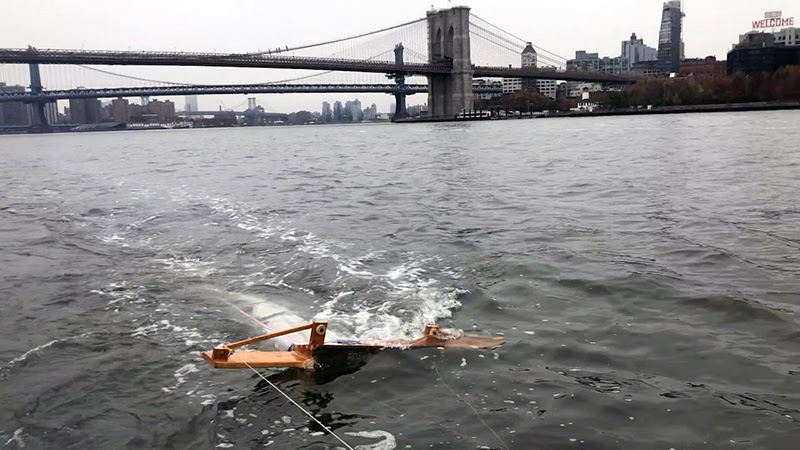
Sebi continues, “In the picture above, some juniors are lowering a Neuston Net into the water. In the picture below, the net is capturing water particles just south of the Brooklyn Bridge. The Neuston Net is also called a Manta Tow, and you can see why as it resembles a Manta Ray swimming on the water’s surface.”
11th grade manta tow in action
Mauricio checking flow meter
above: Just before the Senior’s boat trip,
Mauricio shows students how to
adjust a Flow Meter in the Marine Bio Lab.
12th grade rinsing net
Sebi explains more, “In the picture above,
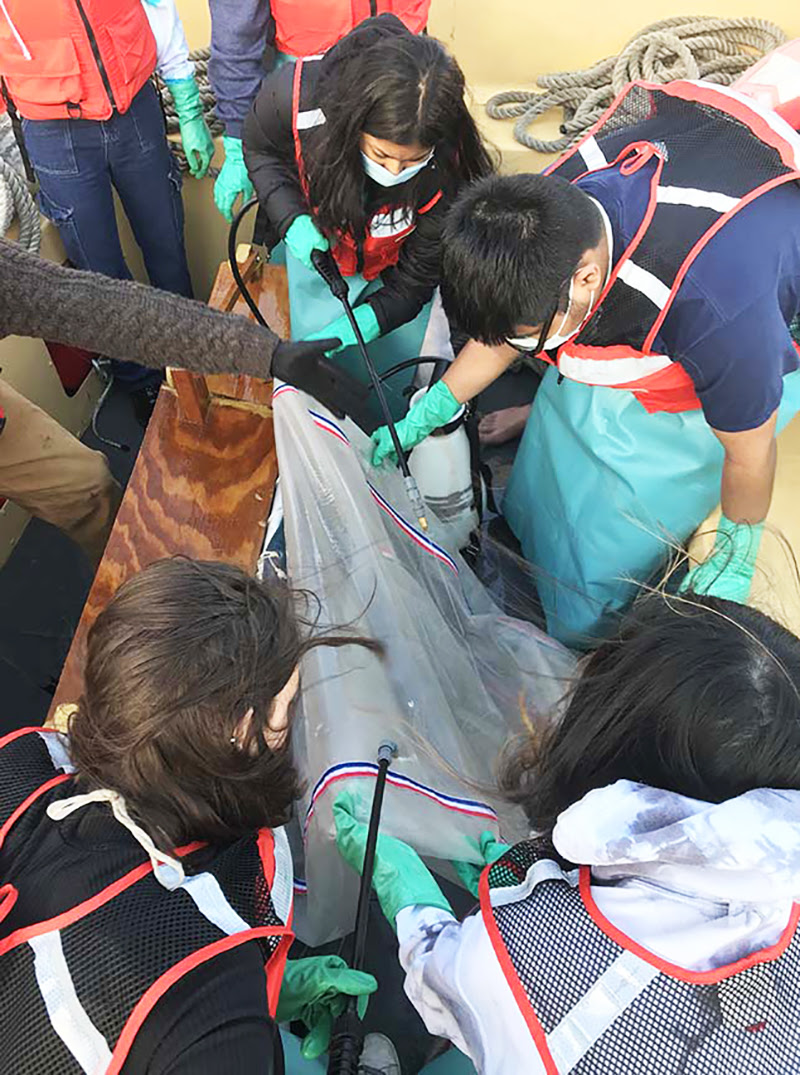
seniors rinse down the net from the Manta Tow
to collect all material that was captured. Below,
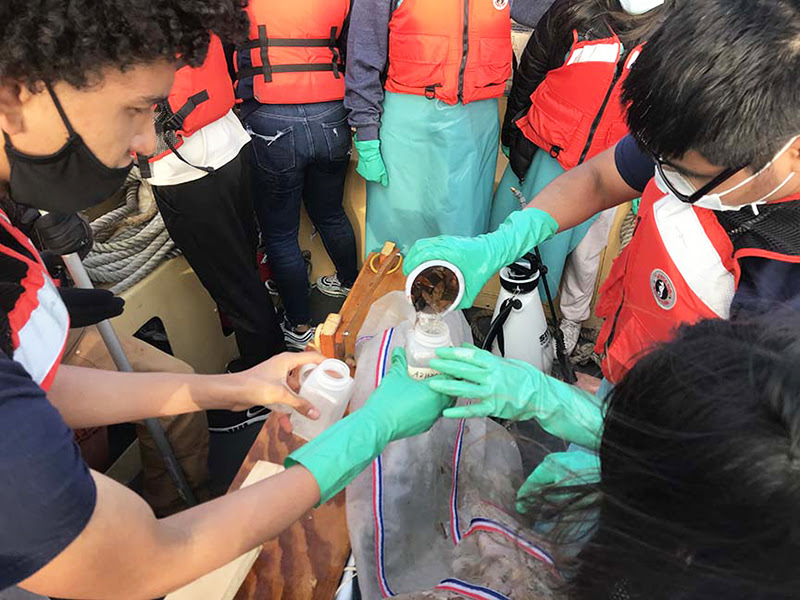
seniors transfer material into a collection cup.
Later, back in our lab, we analyzed the samples
and found plankton, algae, detritus and
sadly, a lot of micro-plastics.”
12th grade collection cup transfer
Please help our students to be able to continue doing
exciting projects like this by donating at  Cheddar Up  
Every little bit helps! Thanks
Thanks to Principal Jeff
and all the parents that
attended our first Marine
Bio Parent’s Zoom Meeting
last month. It was nice to
meet and share. Our seniors
are busy with the college
application process right
now. Parents of juniors and
sophomores asked for
college info, as it is never
too soon to start planning.
We are including some links
below. Please share info
you have that our families
may be interested in.
Comments? Questions?
Contact your Marine Bio Reps
Tricia Garcia & Koko at
marinebio@kokobaz.comThanks to Angie Martinez,
Nan Richardson and Tricia Garcia
for pictures and content.

Design by Koko   www.kokobaz.com

10TH ANNUAL, 2nd VIRTUAL, NYHS MARINE SCIENCE SYMPOSIUM

You’re invited! On June 17, the New York Harbor School will be hosting its 10th Annual Marine Science Symposium through the digital cloud! Experience environmental science from our very own Marine Biology Research and Harbor SEALs scholars. Our honored keynote guests will be Dr. Kathleen Nolan, Chair of Biology at St. Francis College and Mr. Andrew Sommer, alumnus NYHS, class of 2015. Dr. Nolan and Mr. Sommer will share their personal and professional journey through the exciting world of scientific research. In addition, we will be honoring this year ’s NYC Terra ISEF Fair participant, Katherine Mumford, our post-secondary and industry partners, our MBRP symposium finalists, and our Manhattan Borough President, the Honorable Gale Brewer! Please take a moment to view our MBRP Class of 2021 websites.

The MBRP community would like to extend a warm thanks to our NYHS custodial staff, Mr. Benito Nunez, for assuming the oversight of the Marine Science lab for the complete year of the pandemic. Mr. Nunez has kept over 100 tilapia, various tropical freshwater and saltwater invertebrates, fish, reptiles, and amphibians alive and healthy! Benny – Thanks-a-million! The MBRP and the NYHS is tremendously fortunate to have you on the team!

Lastly, it’s with great grief that I inform you of the passing of marine restoration scientist and friend, Dr. Shimrit Perkol-Finkel, after an accident in her native Israel. We are most grateful to have had the opportunity to work alongside Dr. Perkol-Finkel over the last 10 years. Her legacy will live on as her company, Econcrete Co., continues to innovate and build biodiversity-attracting solutions into our coastal infrastructure. This symposium is dedicated to Dr. Perkol-Finkel.

If you’d like to participate as a judge during the fair, you may use this link.

Brought to you by our MBRP class of 2021 (and 2022) scholars.

MARINE BIOLOGY RESEARCH & SEALS 2018-19: SPRING SEMESTER IN REVIEW

MBRP class of 2019! (Selfie credit: Rosalia Elslamony)

Every graduating class has a personality of its own molded by each individual and the particulars of the school cohort. This year’s graduating class was characterized by many unique and strong personalities. What they all had in common though was honesty. I have never met so many young MBRP scholars in tune with themselves and the spirit of the times. I’m most grateful to this particular group for having embodied a crucial component of the program which is independence. This characteristic allowed them to pull through and manage the many aspects that running a high school research program requires. From maintaining our various recirculating lab systems, managing the 8th Annual Marine Science Symposium, competing in the New York City Science and Engineering & Urban Barcode Research Program fairs, completing professional maps using ArcGIS, working thousands of internship hours, earning dozens of college credits, and, most importantly, enhancing environmental awareness of the Hudson-Raritan Estuary, this group of graduating scholars will be making big waves in our world for the better in the years to come. To get to know our graduating MBRP Class of 2019 better, click here to view their ePortfolios.

8th Annual New York Harbor School Marine Science Symposium (Photo credit: Mauricio González).

On May 15 the New York Harbor School hosted its 8th Annual Marine Science Symposium. We had over 50 projects on display and over 30 volunteers from various industry & post-secondary institutions. Among the volunteer judges of the student projects was a team from Con Edison, which has generously supported Marine Biology Research at Harbor School for several years. This year’s theme was the Oroboros- a symbol of chaos and order. The inquiry process, which lies at the heart of research, involves the brave act of taming the chaos inherent in the unknown to try to extract some kernel of truth only to realize that new questions have sprung up and the process continues. Research requires the delicate balancing act between finality and infinity, end and renewal.

8th Annual New York Harbor School Marine Science Symposium group shot (Photo credit: Anita Morawski).

This year’s winner of the MBRP Trident Award of Excellence was bestowed to Marcus Charles (Class ’18). The Trident Award is given to a MBRP graduate that has accomplished all three of the following feats: 01) has earned all the possible college credits offered by the MBRP, 02) has competed in the NYC Science and Engineering Fair or obtained GIS SPACE certification, and 03) has assumed a leadership position in the Harbor SEALs Citizen Science after school team. To view the Symposium Booklet with the complete list of volunteers, senior autobiographies, project titles, and Symposium results click here.

Prof. Henry Bokuniewicz from SUNY Stony Brook mentoring our 10th Grade MBRP scholars Gabriel Castro and Emily Lysakova (Photo credit: Mauricio González).

Our work is not possible without the ongoing support of industry and Post-secondary partners such as ConEdison, SUNY Stony Brook, Bronx Community College, BMCC, Urban Barcode Program, Roger Williams University, SUNY Albany, NYC Department of Education, New York Harbor Foundation, and Rozalia Project, to mention just a few. The opportunities they grant our scholars serve to enrich their education and help make them college and career ready.

Emily Lysakova and Gabriel Castro present at the 2019 Conference on the Geology of Long Island and Metropolitan New York (Photo credit: Lysakova family).

An example of the benefits of the synergy between our partners and the MBRP is our yearly completion of long term research projects, many of which compete at the New York City Science and Engineering Fair with NYC’s brightest STEAM students. We had four competitors in this year’s regional fair with our MBRP research scholar, Cyd Bloomfield, placing third in the category of Earth & Environmental Science. Thank you to Dr. Elizabeth Burmester for mentoring many of this years projects. Go New York Harbor School Science!

New York Harbor School at the 2019 NYC Science and Engineering fair.

In the field, our young Harbor SEALs scholars have been hard at work. Our Microbiology/Plankton and Phys-Chem teams have been monitoring the health of our Harbor waters. Our Biodiversity team has been preparing Econcrete tiles to deploy off of Governors Island for long-term monitoring. And our freshmen and sophomore scholars have been hard at work learning the ropes to take over leadership of their teams next school year.

Harbor SEALs team Plankton. Left to right: Kate Mumford, Taina Berrios, Sunita Pearson_Siegel, Luke Samton (Photo credit: Mauricio González).
Harbor SEALs team Phys-Chem, Right to left: Adult mentor Sean Lynch, Malik Ford, Dakota Rogers, Brian Mejia, and, visiting scholar, Jasmine Mendoza (Photo credit: Mauricio González).
Harbor SEALs team Microbiology/Plankton, Left to right: Kate Mumford, Prophet Davison, Aelish Mullaney , and Mimi Katz (Photo credit: Rosalia Elslamony).

Our alumni have been graduating from college and many continue to visit throughout the year. This past month I attended two graduation ceremonies. Our scholars report that college is not easy. Many struggle to adapt to the rigors of academic expectations and many are also the first to go to college in their families. I am pleased to also mention that colleges are starting to support our minority students by creating special associations that our students can go to for guidance. These associations also provide career assistance after graduation. Common themes I heard in our various conversations were 01) don’t be afraid to ask for help from your professors, 02) take advantage of office hours, 03) go the extra mile so your professors take you under their wing, 04) completing research in the MBRP opened doors for students, 05) don’t let impostor syndrome creep in, you’re not alone! Again, ask for help.

Violeta González, Jade Gonzáles, Andrew Sommer, and Tahirah Abdo, MBRP Class of 2015, graduate from SUNY Oswego.
Violeta González, MBRP Class of 2015- my daughter:) (Photo credit: Anita Morawski).
Nicole Martinez, MBRP Class of 2015, graduates from Columbia College (Photo credit: Anita Morawski).
Katha Conklin and Jared Rosin, MBRP Class of 2017, visiting during our Symposium.

It has been an honor for me to have been awarded the NYC Big Apple Award for the 2018-19 school year. As a part of this recognition, I’ve had the privilege of participating in advisory meetings with Chancellor Carranza and his talented staff. I have also been a part of Academy for Teachers Master Classes that have enriched my intellectual growth. I’d like to end this update by dedicating it to my late mentor, Dr. Gregory Hodge, who passed in February 2019.

Academy for Teachers: Three-Day Master Class on the Hudson River Valley: Art, History, Ecology
(Photo credit: Academy for Teachers).
Big Apple Award: DOE Chancellor, Richard Carranza, Founder and Director Marine Biology Research Program & Harbor SEALs Citizen Science, Mauricio González, and UFT President, Michael Mulgrew (Photo credit: NYC DOE).
My late mentor, Dr. Gregory Hodge , circa 2009 (Photo credit: Anita Morawski).
My wife Anita Morawski’s “love cakes” for the Harbor SEALs (Photo credit: Elizabeth Burmester).